
What is the difference between a ChatGPT app and a hotel chatbot?
A hotel chatbot is a chat window on the hotel’s own website, and it answers guests who have already arrived there. An app sits inside an assistant such as ChatGPT or Claude and answers people planning a trip there, without their opening your site. The difference is where the guest is when they ask.
Take a family who want to know whether the kids’ club takes a 3-year-old. If they are on your website, they ask the chatbot: a product such as HiJiffy answers on the website, on WhatsApp and on social channels, and says it connects to more than 100 hotel systems, including property management systems (PMS) and booking engines. If they are comparing three hotels in ChatGPT, they ask ChatGPT, which can pass the question to your app.
Four things are sold to hotels as “AI” today. Besides the chatbot and the app there is the custom GPT, a version of ChatGPT briefed with your own texts, and a place inside someone else’s app: an online travel agency (OTA) such as Booking.com or Tripadvisor, or a direct-booking technology provider such as The Hotels Network. Our guide to ChatGPT apps for hotels explains what an app is and which groups already have one. The table sets the four routes side by side.
| Compared | Chatbot on your site | Custom GPT | Your hotel’s own app or connector | A place in a shared app |
|---|---|---|---|---|
| Where it is | On the hotel’s website; some on WhatsApp too | Inside ChatGPT, in the GPT directory | Inside ChatGPT and Claude, under the hotel’s name | Inside ChatGPT or Claude, in an OTA’s or a provider’s app |
| Who it answers | A guest already on your site | Someone who opened that GPT on purpose | A guest who already knows your hotel’s name | A guest who is still choosing a hotel |
| How the guest reaches it | Opens the chat window on the page | Opens it, or types @ and its name | Installs it from a link or the plugin directory, then types @ and its name | Installs the OTA’s or the provider’s app; your hotel is among the results |
| What data it needs | Answers the hotel has approved; for prices, the booking engine | Written instructions and uploaded documents | Rooms, prices and conditions from the booking engine, with the date | The content and rates you give the OTA or the provider |
| Who maintains it | The chatbot provider, and whoever updates the answers | Whoever created it | You or your developer; each new version of the package is reviewed | The OTA or the provider |
| Its limit | Reaches no one who is not on your site | Will not last: OpenAI is retiring it | Did not open by itself in our tests (0 of 3); takes no payment in the chat | Does not carry your name: you sit beside other hotels |
Every cell comes from a provider’s page or from a test of our own. The chapters below say which.
Is a custom GPT enough for a hotel’s guest questions?
A custom GPT is the one route not to start down today, because OpenAI is retiring custom GPTs. On its page about moving custom GPTs to plugins it says it is turning them into plugins, that creating new ones will stop first, and that at retirement they will stop working. The page is written for ChatGPT Enterprise administrators and for anyone who has built a GPT. It gives no date, and warns that timings may differ on other plans.
A custom GPT is ChatGPT with three things added: instructions you write, documents you upload for reference and, if needed, “actions” that query an outside service. It never appears in a conversation unasked: according to the same page the user has to open it, or type @ and its name in ChatGPT on the web. For a hotel that means giving every guest the link.
If you already have one, the work is not wasted. Instructions and documents carry over into the plugin that replaces it. Actions do not: they have to be rebuilt as a connection to a server, the same server an app needs.
How does a guest reach your hotel’s app?
A guest reaches your hotel’s app only if they already know about it: they install it from a link or from the plugin directory, then ask for it by name. Left to itself, ChatGPT did not open ours in any of 3 tries.
On 4 October 2026, with our own app installed, we put 12 questions to ChatGPT as a traveller would, along the lines of “which Maldives resort for our honeymoon?”. In 3 of them we did not name the app: ChatGPT searched the web and the app stayed shut. In the other 9 we typed “@Lumina” before the question, and it opened the app all 9 times.
Lumina’s tests in ChatGPT, fast model, 4 October 2026: 12 questions on one account, enough to show the direction.
Companies that sell a shared app teach travellers the same habit. On The Hotels Network’s page the sample question starts with the app’s name: “The Hotels Network, find pet-friendly hotels in Barcelona”.
The rules point the same way. OpenAI says on its page about plugin review that a published plugin is found through a direct link or by searching for its name. In Claude, connectors in the directory can be suggested, ranked by use; connectors added by hand are never suggested.
A chatbot has no such hurdle. It is already on the page the guest is looking at.
Where does a guest who is still choosing go?
A guest who is still choosing goes through the assistant’s web search and, among apps, through those of the big OTAs and comparison sites. The chatbot, the custom GPT and your own app come in later, once the guest has your name.
81 of 387
travel plugins with the word “hotel” in their name or subtitle.
ChatGPT’s plugin directory, Travel category, counted by Lumina on 8 October 2026.
On 3 October 2026 we put 6 travel questions to an OpenAI model inside Codex, OpenAI’s tool for developers, which shows what the model goes looking for. It was free to search for a plugin to suggest. It did so for none of the 6, not even for “hotel in Paris under €400”: it searched the web.
- 0 of 6
- travel questions for which the model searched for a plugin
- about 150
- of the 3,915 plugins in the directory: the catalogue the model can search
- 3
- travel names in that catalogue: Booking.com, Tripadvisor, Skyscanner
Lumina’s tests in Codex, 3 October 2026, with 75 searches run to probe the catalogue. We had counted the 3,915 plugins in the public directory on 2 October.
When we asked it outright whether a plugin existed, it searched a short catalogue: about 150 of the 3,915 plugins we had counted in the public directory on 2 October. Three of them were for travel: Booking.com, Tripadvisor and Skyscanner. Marriott, Hilton and Hyatt did not come up even when we searched for them by name. We measured this in Codex; OpenAI does not publish how ChatGPT decides what to suggest to someone chatting.
The public directory, meanwhile, is crowded. On 8 October 2026 the Travel category of ChatGPT’s plugin directory held 387 listings, and 81 had the word “hotel” in the name or subtitle. The subtitles make the same two promises again and again: search and book.
So a guest who has never heard of you meets you in the pages the assistant reads, and in the OTAs’ apps if you sell there. In our study of 3,288 answers from ChatGPT, Claude and Gemini, carried out in August 2026, questions about the trip named one of the world’s 50 best hotels in 189 of 1,380 answers. The guide on how to get your hotel on ChatGPT explains how to get into those answers.
What does the guest see inside the chat?
Inside the chat the guest sees a card of 527 × 480 pixels, set between the lines of the conversation. On your own website you decide how big the chatbot’s window is; in the chat the assistant decides.
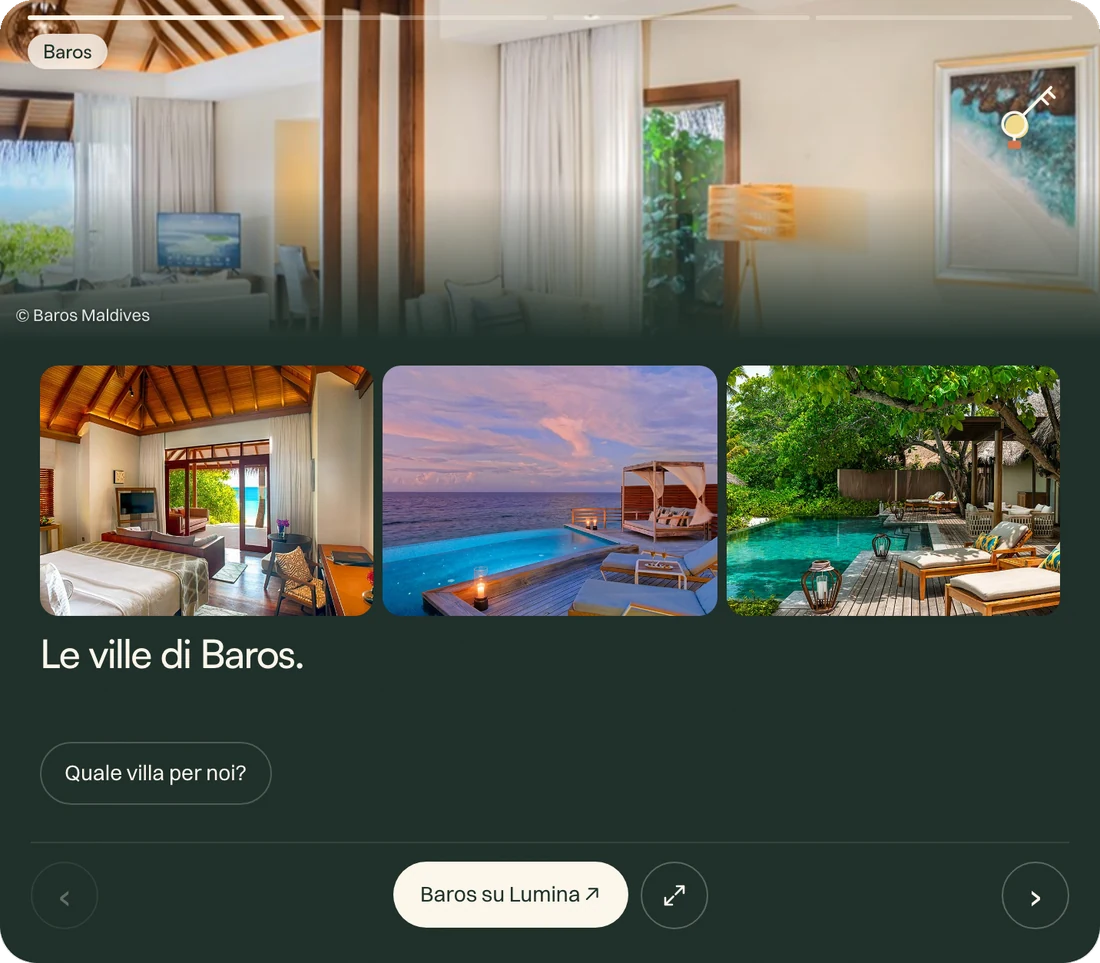
We measured it between 4 and 6 October 2026. In ChatGPT anything that does not fit in 527 × 480 pixels scrolls inside the card; in Claude ours measured 467 × 445. ChatGPT’s enlarge button opens a panel beside the chat about 370 pixels wide, even in a window 1,440 pixels wide.
On 4 October we tested, one at a time, what a card can do in ChatGPT. Photos work, as do a silent video that starts by itself, a map, scrolling sideways and down, and buttons that send the assistant a follow-up question. The card can also fetch fresh data from the server, when the guest changes the dates for instance, without the assistant writing its answer again. Copying to the clipboard, the phone’s share menu and picture-in-picture video do not work. To let a guest share something you need a link to a page on your own website. In Claude, YouTube videos do not load.
- 4 s
- our server’s slowest answer on 6 October; its fastest took 0.6 s
- 67 s
- the slowest complete answer in ChatGPT on 4 October; the fastest took 12 s
- 42 s
- one family question after our changes; without the app, 1 min 32 s
Timed by Lumina in ChatGPT between 4 and 7 October 2026.
The assistant is where the time goes. On 6 October we timed each kind of request to our server: 0.6 to 4 seconds. In our tests of 4 October, though, the complete answer in ChatGPT took 12 to 67 seconds to arrive, because the model has to read the data and then write. We followed one question from version to version, about a family with two children: on 6 and 7 October, once we had cut what we give the model to read, it came down from 2 minutes 50 seconds to 42 seconds. ChatGPT without the app had taken 1 minute 32 seconds.
Can you take bookings or advertise inside the app?
Inside the app you can neither advertise nor take payment for a booking: OpenAI’s guidelines forbid advertisements and require the purchase to be completed outside, on the seller’s own website. Payment inside ChatGPT, which OpenAI calls Instant Checkout, is in beta with a few selected marketplaces. A plugin’s directory listing may not announce discounts or promotions.
The apps we looked at follow the rule. ALL Accor, announced on 29 January 2026, searches in the chat and sends the traveller to the ALL platform to book. Booking.com’s listing invites you to tap “View on Booking.com”. The Hotels Network says in its frequently asked questions that the booking takes place on the hotel’s website.
None of these rules applies on your own website. There the chatbot can show a visitor an offer and take them to the booking engine. That is the biggest practical difference: in the app the guest finds out and chooses; on the website they book.
Which should you choose, and what should you do this month?
The choice depends on how many hotels you have and where your guests ask their questions. For every hotel the work starts with written answers, which all four routes rely on.
| Your situation | Where to start | Why |
|---|---|---|
| An independent hotel | Written answers on your website and, if the same questions keep coming, a chatbot. For the assistants, your booking engine provider’s app | The app serves a guest who already knows your name; the website and the chatbot serve one who is looking at you now |
| A small collection on one booking engine | An app in the collection’s name, built by the provider | One connection and a name a guest can remember, as with Preferred Hotels & Resorts |
| A group with a central reservation system | Its own app in ChatGPT and Claude, and an assistant on its website | Marriott has a plugin in ChatGPT and Ask Bonvoy on Marriott.com; Accor sends the booking to ALL |
Marriott introduced Ask Bonvoy on 16 June 2026: a natural-language search on Marriott.com and in its apps, in beta and in US English, which answers only from the group’s own data. It also has the Marriott Bonvoy plugin in ChatGPT’s directory. A group does both at once; an independent hotel can get there through the providers it already uses.
Write to your booking engine provider
Three questions: do you publish an app or a connector in ChatGPT and in Claude? Under what name does my hotel appear? What will I see of guests’ questions?
Write down the answers you give every week
Children by age, how to get there, what each board basis includes, each with its date. The chatbot, the app and the assistant’s web search all read them.
If you have a custom GPT, prepare the move
Save its instructions and documents: they go into the plugin that replaces it. The actions will have to be rebuilt.
Look at a real card
Add an app to ChatGPT or Claude and ask it a question as a guest would. You will see how much space you get and how long the guest waits.
To see a card, you can use our app. You add it by hand, in a minute, from the page that explains how to use Lumina in ChatGPT and Claude. It is not yet in ChatGPT’s public directory: the package has been ready since 7 October 2026, and OpenAI has still to verify our company’s identity. The guide to MCP and direct bookings explains how an app connects to the booking engine through a protocol called MCP. Our development brief lists what to ask whoever builds your app.
Questions hotels ask
- Can an existing hotel chatbot become a ChatGPT app?
- In part. The approved answers your chatbot uses, on hours, policies and rooms, are the ones an app needs. They still have to be put on a server that speaks MCP, the protocol an assistant uses to query a service, then packaged and sent to OpenAI for review; the chat window and the WhatsApp connections do not carry over. Ask your chatbot provider first whether it already publishes an app. The guide to MCP and direct bookings explains how the connection works.
- Are ChatGPT apps, plugins, connectors and custom GPTs the same thing?
- The first three are; the fourth is a different product. OpenAI now calls the package you install a plugin and the connection to a service inside it an app; in Claude the same connection is a connector. A custom GPT is an earlier product, made of instructions and uploaded documents, which OpenAI is turning into plugins. The names and dates are in the guide to ChatGPT apps for hotels.
- Will a ChatGPT app reduce OTA commissions?
- Only if a guest who would have booked through an OTA reaches your booking engine instead, and we found no public figure for how many do. Terms differ from one provider to the next: The Hotels Network advertises a flat fee with no commission, SiteMinder a commission on completed stays for Channels Plus. To find out for your own hotel, count the bookings that arrive through the app’s link, which carries a tag at the end of its address.
- What does the app’s publisher see of my guests?
- The publisher sees the request the assistant composes; the message as the guest typed it never reaches them. Our own server receives the destination, dates, guests and requests as written by ChatGPT, plus the language and an approximate location. In the plugin directory ChatGPT warns that it may share relevant chats and memories with the app. If the app belongs to a provider, that data goes to the provider: ask them to put in writing what you will receive.
- What do Accor’s and Marriott’s choices teach an independent hotel?
- The groups put the assistant where the guest already is and keep the booking on their own system. Accor announced the ALL app in ChatGPT on 29 January 2026, in more than 20 languages, with the booking on the ALL platform. Marriott has a plugin in ChatGPT and, since 16 June 2026, Ask Bonvoy on its own website, in beta. An independent hotel gets the same split with a chatbot on its website and its booking engine provider’s app.
Find the right route for your hotel
Tell us which booking engine you use and where your guests ask their questions, and we will work out with you which of the four routes is open to your hotel and what to ask your provider. Meanwhile you can look at a real card: our app is added to ChatGPT or Claude in a minute.
Talk to us about your hotelTry Lumina in ChatGPT and Claude Get the report
 Sources read on 8 October 2026. What a platform allows changes often; each claim links the page it comes from.
Sources (16)
- OpenAI: moving custom GPT workflows to plugins
- OpenAI: plugin guidelines, checkout and advertising
- OpenAI: plugin review and how plugins are found after publication
- OpenAI: submitting a plugin, publisher identity and new versions
- ChatGPT: plugin directory, Travel category, read on 8 October 2026
- Anthropic: Claude’s connector directory and suggestions
- Anthropic: directory connectors and custom connectors
- The Hotels Network: the direct booking app in ChatGPT, 4 March 2026
- The Hotels Network: the app for travellers, instructions and questions
- SiteMinder: distribution through AI assistants
- Mirai: MCP to connect the hotel to AI agents, 12 March 2026
- Kismet: a hotel-branded ChatGPT app
- HiJiffy: hotel chatbot, channels and integrations
- Accor: ALL Accor in ChatGPT, press release of 29 January 2026
- Marriott: Ask Bonvoy announcement, 16 June 2026
- Lumina: a study of 3,288 answers from ChatGPT, Claude and Gemini