
What is hotel MCP?
Hotel MCP is the connection that lets an assistant such as ChatGPT or Claude query a hotel’s systems while the guest is typing. MCP stands for Model Context Protocol: a shared, public language in which an assistant asks an outside service for data and gets it back in a form it can read.
It works like a plug socket: one shape, and any appliance fits without an adaptor. Before MCP, every assistant needed a connection built for it alone. Anthropic published MCP as an open standard on 25 November 2024; Claude and ChatGPT both use it today, and the protocol’s own site compares it to a USB-C port.
In practice an MCP server is a web address with a program behind it. A guest types “do you have a family room from 3 to 6 August, with two children?”. The assistant turns the question into a structured request, with dates, adults and the children’s ages, and sends it to that address. The server replies with data and, where it helps, a card the assistant shows in the conversation. Each thing the server can do, such as searching for a room or reading a price, is called a “tool”.
Ours is a single server that both ChatGPT and Claude call, and nobody has to log in to use it. How a server becomes an app with a name, a listing in the plugin directory and a review is covered in our guide to ChatGPT apps for hotels.
What reaches the hotel’s server?
The hotel’s server never receives the message the guest typed. It receives the request the assistant composes from that message, which holds the details the server asked for, such as destination, dates and guests. ChatGPT adds the language, a rough location such as city and country, and an anonymised user identifier: all three are listed in OpenAI’s technical reference.
The assistant can also add things the guest never typed in that conversation. In one test on 3 October 2026 we asked ChatGPT for a Maldives resort for a honeymoon and said nothing about money. The request that reached our server carried a budget of about $1,000 a night: the user had mentioned it in another conversation, and ChatGPT added it unprompted.
Your privacy notice should describe what actually arrives: structured requests, with a language and an approximate location. OpenAI’s guidelines ask for a public page that states five things: which personal data you receive, why, who sees it, how long you keep it and what choices the user has. If you log requests to learn what guests ask, say so there. And allow for a budget or a child’s age arriving from the assistant’s memory.
Which system holds the data a guest asks for?
The data a guest asks for sits in several systems, and the server has to know which one to ask. The hotel knows what a room is like and what the house rules are. The booking engine knows what tonight costs and which rooms are left.
| What the guest asks | Who holds the answer | What that means |
|---|---|---|
| What the room is like, how many it sleeps, the view from the window | The hotel: its site, room descriptions, photos | Written once, with a date, and reread when it changes. |
| How to get there, the kids’ club ages, whether dogs are welcome | The hotel | Rarely in the booking engine: you supply it. |
| The price from 3 to 6 August for two adults and two children | The booking engine or central reservation system (CRS) | It needs a live answer, with taxes and conditions. |
| Whether that room is still available | The booking engine and the channel manager | The answer is true when it arrives; a minute later the room may have been sold. |
| My booking, my details | The hotel’s property management system (PMS) | The guest has to log in, and separate permissions are needed. |
0 of 12
traveller questions for which our app held two comparable prices for the same trip.
Lumina’s test of its own app, 4 October 2026.
Until one of those systems answers, a price in a chat is only a guide. Our own app is not connected to any booking engine: it shows prices collected from public sources, with the day we read them. That is where we learned how little it takes to get a price wrong.
On 4 October 2026 we put 12 traveller questions to our app, such as “which Maldives resort for our honeymoon?”. For none of the 12 did we hold two prices that could be compared. One source priced the right number of people and listed taxes separately; the other included taxes and did not say how many people the price covered. So the budget was never applied: a request for $1,500 a night was answered with a villa at $2,645.
The same day, for one resort, the card showed $2,101 a night and ChatGPT’s text said $1,101. Both were real: a pool villa from 16 to 23 January, and the cheapest room from 12 to 16 January. The guest sees a contradiction. A single price for those dates and those people, taxes included, can only come from the booking engine.
Which providers already offer an MCP connection for hotels?
In October 2026 at least five hotel technology providers and one booking portal offer an MCP connection for hotels. We reread their pages on 8 October 2026: the table gives what each one states, its date, and what the page itself says is not there yet.
| Provider | What it states | Date | What is missing, by its own account |
|---|---|---|---|
| Mirai, booking engine | Every client has an active MCP server with content, live availability and rates, plus the functions to create, modify and cancel a reservation. | 12 March 2026 | Plugins in ChatGPT arrived on 23 September 2026, for a few clients only so far. |
| Simple Booking, Zucchetti Group | MCP connectors in production for clients, partners and groups: about twenty tools that read property information, rate plans, packages, live availability and prices. Tested with Claude and ChatGPT, with OAuth access. | 8 June 2026 | The release names no tool that creates a reservation. Further tools are announced as coming. |
| SiteMinder, channel manager | Two products. Channels Plus MCP opens the hotel to AI travel platforms, with commission on completed stays. Direct Booking MCP shows it in ChatGPT, Gemini and Claude inside a partner’s app, with live rates and a link to the booking engine. | Page dated 14 April 2026, updated 20 May | More platforms are promised soon. The DirectBooker partnership is described in the future tense. |
| The Hotels Network, part of Lighthouse | One app shared by its client hotels, live in ChatGPT’s directory: content supplied by the hotel, live rates and a link to the hotel’s own site to book. Flat fee, no commission. | 4 March 2026 | The announcement covers ChatGPT only. Other assistants are left for when they open up. |
| Apaleo, PMS | An MCP server across its whole platform, so AI agents can read hotel data and carry out operations such as checking availability and modifying a booking. | 22 September 2025 | It concerns the hotel’s own operations and invites readers to a trial group, the MCP Alpha Group. It names no guest-facing app. |
| Booking.com, portal | An MCP server hosted by Booking.com for companies building travel assistants: search tools over properties, prices and availability. | Undated; on 8 October it showed as updated a week earlier | Limited to approved partners. Creating the booking is not included. |
4
the first Mirai clients with a plugin of their own in ChatGPT: two hotels in Madrid, a chain in Granada and a group in the Canary Islands.
Mirai’s announcement of 23 September 2026, reread on 8 October.
Announced and available are two different states in that table. Mirai and Simple Booking say the server is live for clients, and The Hotels Network says its app is published. SiteMinder puts part of its offer in the future tense, and Apaleo invites readers to a trial group.
Reading data and taking a reservation are also two different abilities. Mirai states that it creates, modifies and cancels reservations. The Hotels Network and SiteMinder’s direct product send the guest to the booking engine. Booking.com leaves booking creation out of its server.
The first plugins from Mirai’s clients, announced on 23 September 2026, belong to Hotel Emperador and Hotel Moderno in Madrid, Porcel Hoteles in Granada and Gloria Thalasso & Hotels in the Canary Islands. Mirai itself writes that it does not expect these first plugins to bring in volume straight away. We have not tried any of these connections with a hotel’s credentials: ask your provider for a demonstration on your own account.
Does a hotel MCP server work in ChatGPT, Claude and Gemini?
A hotel MCP server works in ChatGPT and Claude, which both accept a third party’s server. For the Gemini app, Google’s help page describes no way of adding one. One server covers the first two: ours answers ChatGPT and Claude from the same address.
| Assistant | How a server is connected | How a guest finds it |
|---|---|---|
| ChatGPT | From the Plugins page: the plus button, “Add custom MCP server”, the server’s address. To reach everyone, submission to OpenAI and review. | By name or through a direct link, in the plugin directory. |
| Claude | As a custom connector, by pasting the remote server’s address: available on the Free, Pro, Max, Team and Enterprise plans. To reach everyone, submission to Anthropic and review. | Directory connectors can be suggested in a chat. Custom ones never are. |
| Gemini | Connected apps are chosen from a list in the settings. The help page does not describe adding a server by its address. | Gemini automatically uses public information from Google Search, Google Hotels and Google Maps. |
For Gemini, then, a hotel’s route runs through Google Hotels and Google Maps. On 2 October 2026 we looked for a form to propose a third-party app to Gemini and found none. SiteMinder lists Gemini among the assistants its direct product reaches, without explaining how.
In ChatGPT a published plugin is found through a direct link or by searching for its name, as OpenAI says on its review page. In Claude any connector in the directory can be suggested during a conversation and one added by hand never is, according to Anthropic’s comparison of the two.
Can guests book and pay inside ChatGPT?
Today a booking that starts in ChatGPT is paid for on the seller’s own site: OpenAI’s guidelines ask this of every plugin. Payment inside ChatGPT, which OpenAI calls Instant Checkout, is in beta and limited to a few selected marketplaces.
The providers have built to that rule. The Hotels Network takes the guest to the hotel’s site in one click. SiteMinder’s direct product shows rates and availability, then hands over to the booking engine. Mirai, by contrast, writes that guests can book through its clients’ plugins without leaving ChatGPT; it has released them for a few hotels, and we have not tried to make a booking.
For a hotel, that gives the conversation and the booking engine one job each. In the conversation the guest chooses the room, the dates and the conditions; on the booking engine they confirm and pay. The connection should take them there with dates, guests and room already filled in. Our own app does not take bookings: every price carries the day we read it and a link to the hotel’s site.
What do travel MCP servers answer today?
All 15 travel MCP servers we queried answer with prices and availability, and none says how you get to the hotel. We queried them on 3 and 6 October 2026: they are public servers belonging to travel and hotel apps, and we did what an assistant would do. First we read each server’s list of tools, then we ran some real searches, such as five-star resorts in the Maldives or the Masai Mara in February.
5
distinct lists of amenities for 25 Maldives resorts, in one travel server’s answer.
Lumina’s test, 3 and 6 October 2026.
What each server declares it can return. Lumina’s test, 3 and 6 October 2026. Another 5 addresses do not answer without credentials and are left out of the count.
All 15 are price lists: they search properties and return prices and availability. None has anywhere to say how you get there: by what transfer, in how many minutes, at what cost and until what time. None has anywhere to put the season, the reef or what guests say.
The answers bear this out. For the Masai Mara in February one server put a $34 campsite with no reviews at the top. A comparison tool, given three Maldives resorts, replaced one of them with a large family resort and did not say so. One chain’s server has a single tool, which looks up the best rate for members and for everyone else. Another search returned 25 Maldives resorts with only 5 distinct lists of amenities between them.
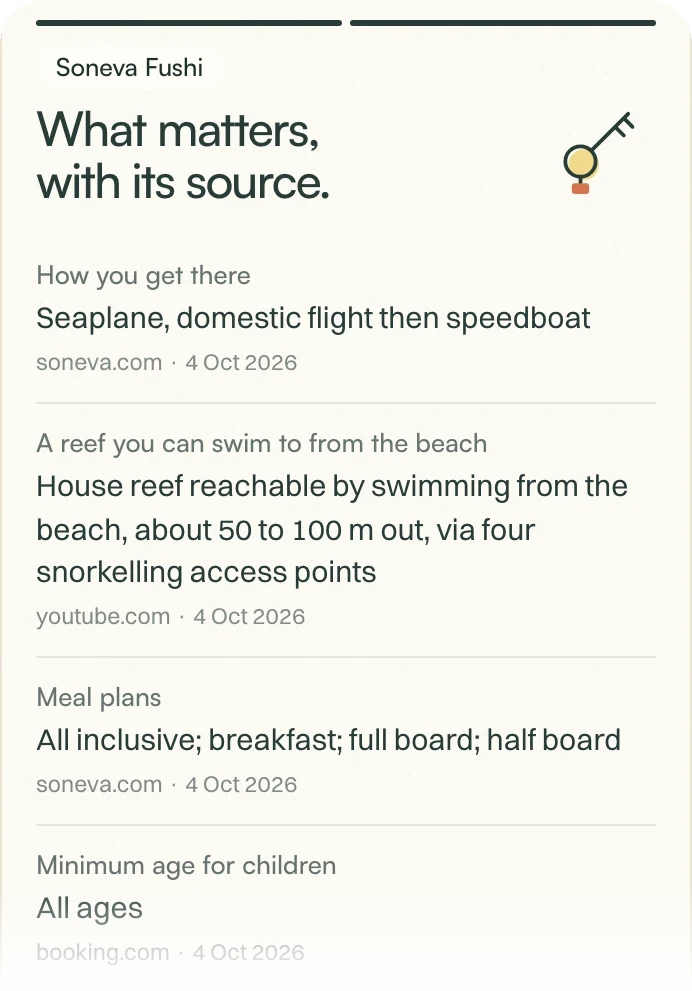
How you get there, which season to go in, what the reef is like: these are the questions that decide a trip, and a price list does not hold them. They are what we put into our app for ChatGPT and Claude: seasons, transfers, entry rules, each with its source. An MCP connection carries what you put into it. Put in rates alone, and rates are all the assistant will know.
What did we learn running our own server?
Running our own server taught us that it should answer briefly and quickly, because the assistant has limited room for an answer and limited time to wait for it. We measured both between 4 and 7 October 2026.
277,649
characters in our server’s answer for one resort comparison on 6 October 2026. Claude accepts about 150,000.
Measured by Lumina; the limit is in Anthropic’s guide to building a server.
The first limit is space. Claude accepts a result of about 150,000 characters from a server and waits 240 seconds at most, as Anthropic’s guide to building a server states. On 6 October our resort comparison ran to 277,649 characters: Claude set it aside and the card stayed blank. We cut it to 118,000 without changing what the guest sees. On 5 October a tool meant to return one fact was returning everything we hold on the hotel, between 133,000 and 391,000 characters; it now returns 3,000 to 17,000.
- 0.6–4 s
- how long each tool on our server took to answer on 6 October
- 44–78 s
- an answer with the map in ChatGPT, the same day
- 42 s
- one family’s question after the fixes; 2 min 50 s before
Measured by Lumina on 6 and 7 October 2026: the tools on the server, the answers in ChatGPT. The family question is a single question, timed four times: 2 min 50 s, 1 min 04 s, 43 s and 42 s. ChatGPT without the app answered it in 1 min 32 s, in one run.
The second limit is time. On 6 October every tool on our server answered in between 0.6 and 4 seconds: 0.8 for prices, 2.1 for reviews, 3.8 for a comparison of six resorts. Yet that day an answer with the map took 44 to 78 seconds in ChatGPT. The rest of the time was spent by the model, the program inside ChatGPT that reads and writes. Because of the way we had written the tools, it had to read a long plan, write a paragraph for each resort and make two calls in a row.
We cut what the model has to read and write, and moved the server from Washington to Frankfurt, closer to the database. One question, from a family with two children, was timed four times on 6 and 7 October and came down from 2 minutes 50 seconds to 42 seconds.
The last test is one we would recommend to anyone: several guests at once. On 4 October, when 4 requests arrived at the same moment, 3 failed, because the server rebuilt a file of about 9 MB each time. After the fix there were no errors with 4, 6 or 8 requests at once.
What should you ask your booking engine provider?
Ask your booking engine provider seven things, in writing, and ask for a demonstration on your own account.
Is it live today, and in which assistants?
An MCP server with an address, or an app already published in ChatGPT’s or Claude’s directory. Get the address or the name, and the date it went live.
What does it return?
The price for the dates and people requested, the children’s ages, taxes included or separate, the meal plan, the cancellation terms.
Does it only read, or does it book?
Whether it creates, modifies or cancels a reservation, and on which page the guest pays.
What does it cost?
A flat fee, a commission per booking or per completed stay. Both models already exist: see the provider table.
What do you receive and keep?
Which parts of the request reach the provider, who sees them and for how long. You need it for your privacy notice.
How do I recognise those bookings?
A code added to the link to the booking engine, which you can find again in your own reports.
Can I add my own content?
How to get there, the arrangements for children at each age, building works: what a price list leaves out.
Where should an independent hotel start?
As an independent hotel, start with an email to your booking engine provider, carrying the seven questions above. It is the shortest route: price and availability live there, and the providers in the table have already built the connection. Building your own is worth it for a group with several properties and one central reservation system.
189 of 1,380
answers that named one of the 50 hotels on The World’s 50 Best Hotels list, when the question started from the trip.
Lumina’s study of 3,288 answers from ChatGPT, Claude and Gemini, August 2026.
Then prepare what no provider holds on your behalf: how to get there, the arrangements for children at each age, meals, building works, in writing and with a date. The full list is in our guide to ChatGPT apps for hotels.
Last, treat being found as a separate job. A connection answers the guest who is already considering you. In our study of 3,288 answers from ChatGPT, Claude and Gemini, run in August 2026, when the question started from the trip and not from a hotel, one of the 50 hotels on The World’s 50 Best Hotels list was named in 189 of 1,380 answers. Getting into those answers depends on the pages of your site: the guide on how to get your hotel on ChatGPT says where to begin.
If you are choosing between an app, a chatbot on your site and a custom GPT, the comparison is in ChatGPT app or hotel chatbot. If you want a quote, start from the development brief.
Questions hotels ask
- Does MCP make a hotel bookable in every AI assistant?
- No. MCP works where the assistant accepts third-party servers, today ChatGPT and Claude, and for the guest who has added the app or calls it by name. On 4 October 2026 ChatGPT opened ours 0 times out of 3 when we did not name it and 9 times out of 9 with “@Lumina” in front of the question. The tests are in our guide to ChatGPT apps for hotels.
- Is channel manager access enough to take a reservation?
- It is enough for prices and availability, which the channel manager already sends to the portals. The reservation is confirmed by the system that knows which rooms are still unsold: in SiteMinder’s direct product the guest sees rates and availability in the chat and completes the booking on the hotel’s booking engine.
- Does a guest-facing app need PMS access?
- Not to answer questions about rooms, prices and availability: the booking engine and the hotel’s own content are enough. The PMS comes in when the guest wants to see or change an existing booking. The guest then has to log in, and separate permissions are needed; for the login MCP uses OAuth, the standard that lets a person sign in to a service without handing over their password. Our own server asks nobody to log in and touches no reservation.
- How do I stop an assistant showing an expired price?
- Have the booking engine answer every question, and have the dates, the number of people and whether taxes are included written next to the price. Booking.com warns in its documentation that availability and prices may change after a response is returned. If the price was collected from public sources, as in our app, say the day it was read.
- How should children’s ages and connecting rooms be handled?
- The request has to carry each child’s age, and the price has to be for those people. On 4 October 2026 our app held prices for two adults only: families were given that price with a note to ask the hotel. Two rooms being available does not tell you whether they connect: if the system does not know, the assistant has to say so.
- How much does an MCP connection cost a hotel?
- It depends on the provider’s model. The Hotels Network states a flat fee with no commission; SiteMinder, for Channels Plus MCP, no upfront cost and commission on completed stays. The other pages we read give no prices. For a server of your own, what to put in the quote is in the development brief.
Find out what your hotel can already connect
Tell us which booking engine you use: we will go through what your provider already offers and which facts to prepare so that an assistant answers well about your hotel. Meanwhile you can see what our own server answers: our app is added to ChatGPT or Claude in a minute.
Talk to us about your hotel’s connectionTry our app in ChatGPT and Claude Get the report
 Sources read on 8 October 2026. What a platform allows changes often; each claim links the page it comes from.
Sources (18)
- Anthropic: introducing the Model Context Protocol, 25 November 2024
- Model Context Protocol: what MCP is
- OpenAI: plugin guidelines
- OpenAI: technical reference, the data ChatGPT sends to the server
- OpenAI: connecting and testing an MCP server in ChatGPT
- OpenAI: plugin review and distribution
- Anthropic: adding a connector that is not in Claude’s directory
- Anthropic: directory connectors and custom connectors
- Anthropic: building an MCP server for Claude, size and timeout limits
- Google: Connected Apps in Gemini
- Mirai: MCP to connect the hotel to AI agents, 12 March 2026
- Mirai: its clients’ first plugins in ChatGPT, 23 September 2026
- Simple Booking: MCP connectors for hotel distribution, 8 June 2026
- SiteMinder: distribution through AI assistants, page updated 20 May 2026
- The Hotels Network: the direct booking app in ChatGPT, 4 March 2026
- Apaleo: the platform’s MCP server, 22 September 2025
- Booking.com: MCP server documentation
- Lumina: a study of 3,288 answers from ChatGPT, Claude and Gemini