'%3E%3Cg transform='translate(0,0.0) scale(5.23438)'%3E%3Cpath d='M34 128 a94 94 0 1 0 188 0 a94 94 0 1 0 -188 0 Z M98 128 a52 52 0 1 0 104 0 a52 52 0 1 0 -104 0 Z' fill='%23FFFFFF' fill-rule='evenodd'/%3E%3C/g%3E%3Cg transform='translate(1455.0,302.5)'%3E%3Cg transform='translate(-84.0,729.0) scale(1,-1)'%3E%3Cpath d='M182.0 723V91H500.0V0H84.0V723Z M908.0 489H1001.0V0H917.0L907.0 74Q886.0 35 841.0 11.5Q796.0 -12 742.0 -12Q658.0 -12 611.0 41.0Q564.0 94 564.0 185V489H658.0V216Q658.0 71 775.0 71Q840.0 71 874.0 112.0Q908.0 153 908.0 231Z M1001.0 0H907.0V489H991.0L1000.0 425Q1019.0 461 1057.5 482.0Q1096.0 503 1146.0 503Q1260.0 503 1301.0 404Q1318.0 450 1360.0 476.5Q1402.0 503 1459.0 503Q1543.0 503 1591.0 454.0Q1639.0 405 1639.0 320V0H1547.0V297Q1547.0 354 1517.5 386.0Q1488.0 418 1438.0 418Q1385.0 418 1352.5 383.0Q1320.0 348 1320.0 290V0H1227.0V298Q1227.0 355 1198.0 386.0Q1169.0 417 1119.0 417Q1065.0 417 1033.0 382.5Q1001.0 348 1001.0 290Z M1749.0 0V489H1843.0V0Z M2053.0 0H1959.0V489H2044.0L2054.0 414Q2077.0 456 2120.5 479.5Q2164.0 503 2216.0 503Q2310.0 503 2357.0 449.5Q2404.0 396 2404.0 299V0H2310.0V278Q2310.0 417 2192.0 417Q2127.0 417 2090.0 374.0Q2053.0 331 2053.0 259Z M2657.0 -12Q2579.0 -12 2534.5 28.5Q2490.0 69 2490.0 136.0Q2490.0 203 2537.5 243.5Q2585.0 284 2672.0 291L2826.0 303V317Q2826.0 428 2711.0 428Q2652.0 428 2619.5 403.0Q2587.0 378 2587.0 334H2505.0Q2505.0 410 2562.5 456.5Q2620.0 503 2715.0 503Q2809.0 503 2863.5 453.0Q2918.0 403 2918.0 307V0H2838.0L2828.0 79Q2809.0 37 2762.5 12.5Q2716.0 -12 2657.0 -12ZM2684.0 61Q2751.0 61 2789.0 101.5Q2827.0 142 2827.0 211V237L2702.0 227Q2585.0 216 2585.0 139Q2585.0 101 2611.0 81.0Q2637.0 61 2684.0 61Z' fill='%23FFFFFF'/%3E%3Cpath d='M1733.0 667Q1733.0 693 1751.0 711.0Q1769.0 729 1795.0 729.0Q1821.0 729 1839.0 711.0Q1857.0 693 1857.0 667Q1857.0 642 1839.0 623.5Q1821.0 605 1795.0 605.0Q1769.0 605 1751.0 623.5Q1733.0 642 1733.0 667Z' fill='%23FFFFFF'/%3E%3C/g%3E%3C/g%3E%3C/g%3E%3C/svg%3E)
What does the first screen of the best hotel websites show?
The first screen of the best hotel websites nearly always shows a film, and the ones that work best show something only that house has. It is what a guest sees before scrolling, while deciding whether to stay or go back to Booking.com.
We wanted to know what is really there in those first seconds. On 23 and 24 November 2026 we opened the websites of 200 hotels in 61 countries, on a desktop (1440×900 pixels) and on a phone (390×844), and took a screenshot after 1, 4 and 9 seconds. They are among the most admired hotels in the world: 47 independents, 28 Belmond, 28 Rosewood, 18 Aman and 79 from other groups.
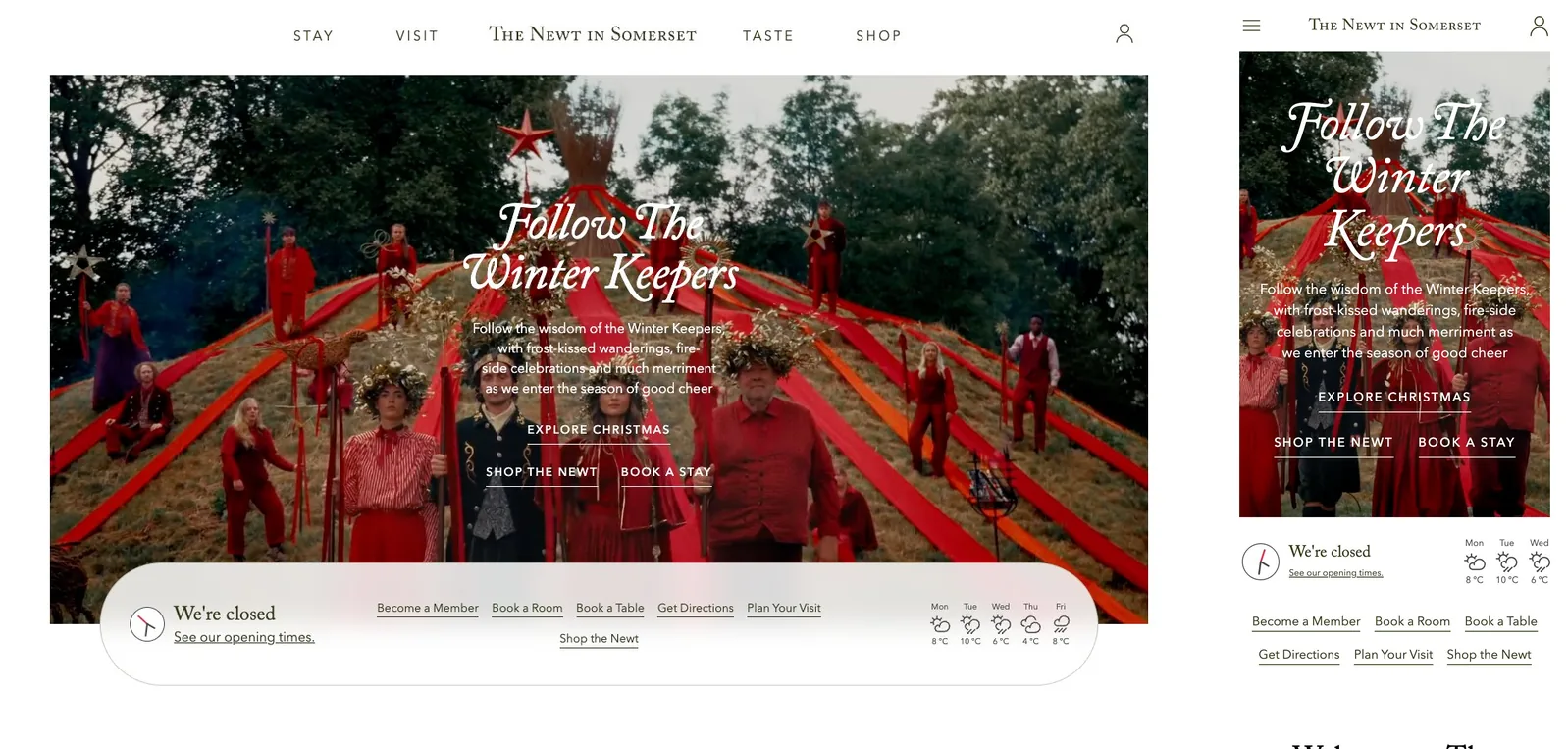
Take The Newt in Somerset. It opens on a crowd dressed in red among red ribbons stretched over a grassy mound, under the title “Follow the Winter Keepers”: the estate’s way into its winter season. The film runs for 39 seconds in 21 shots, and the Winter Keepers are in all 7 of the frames we looked at. Another English country house could have the same lawn; it could not have those figures in red.
Of 200 websites on desktop, 144 open on a film: 120 put it straight into the page, 24 inside a player such as Vimeo. The rest open on a still photograph (40) or on a sequence of photographs that change (16).
Lumina’s captures of 23 and 24 November 2026, recounted on 25 November. 2 still photographs that the automatic count had taken for sequences were corrected by looking at the captures.
Why do some hotel websites feel like that hotel, and others could be anyone’s?
The ones you recognise open on the house: its architecture, a colour of its own, a ritual only it keeps, its history. The others open on the place, meaning the mountain, the beach, the city. The place tells you which destination you are in, but the neighbours have it too.
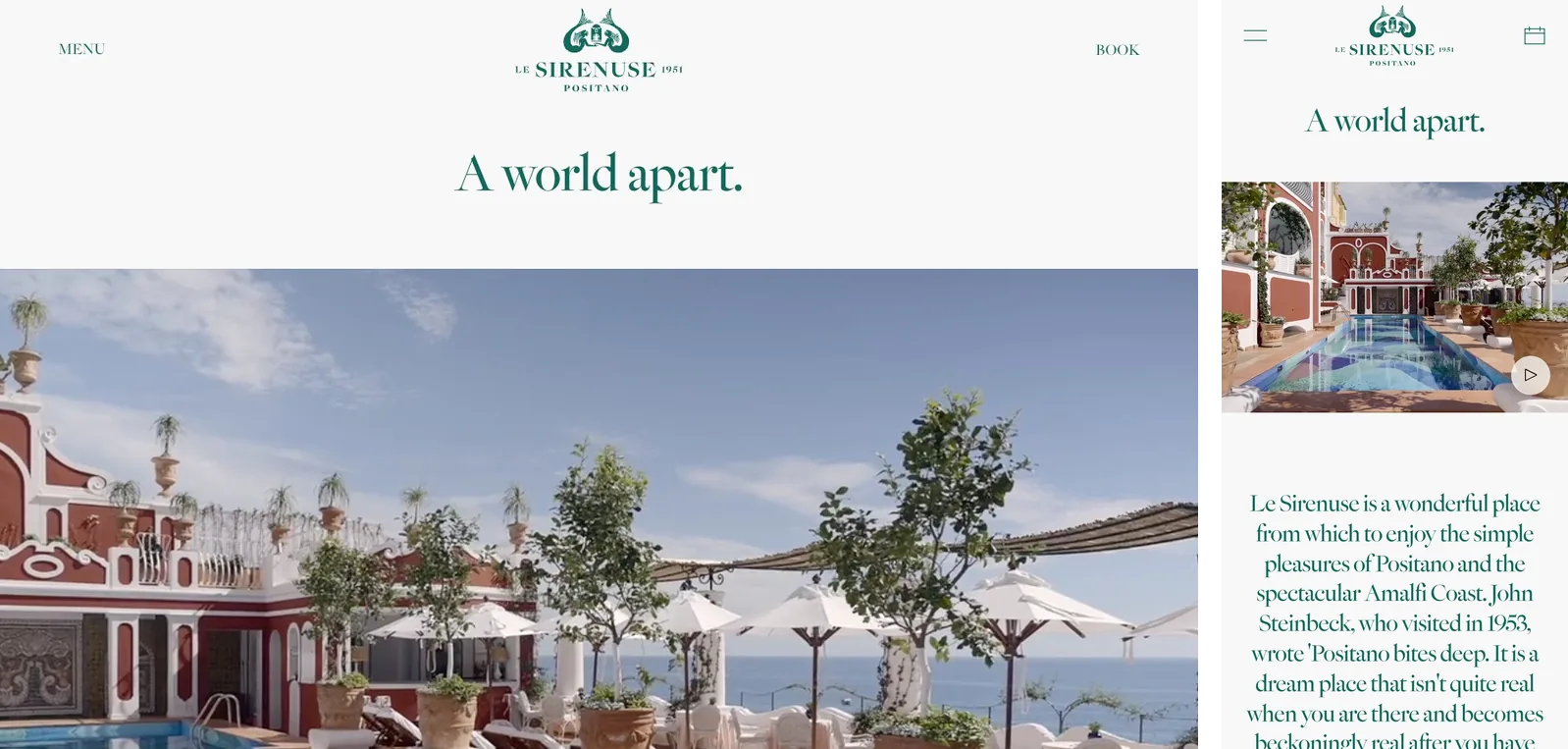
In Positano, Le Sirenuse opens on the line “A world apart.” and, beneath it, the pool terrace: Pompeian-red walls, maiolica, big terracotta pots. The red and the maiolica come back in 4 of the 7 frames of the film. The Caruso in Ravello looks out over the same coast, but it does not have that red.
On 24 November we looked at up to 7 frames for each of the 200 hotels, asking the same question every time: could the hotel next door have shot this? These are judgements, ours on 27 hotels and AI reviewers’ on the rest, made by looking, not measurements. Of 193 openings we could read, 97 show something that belongs to the house, half of them. 30 show only the place. At 50 hotels out of 200, not one shot held up against the neighbour of the same kind.
Judgements made by looking at 7 frames per hotel, by Lumina and by AI reviewers following its rules, 24 November 2026. Only openings we could read are counted: 46 of the 47 independents.
Here the independents beat the big names: 67% against Rosewood’s 21%. A brand gives all its hotels the same page and often the same run of shots, and the house gets flattened into that grammar. A boutique hotel starts with an advantage, as long as it shows the right thing.
What happens when the first screen is about the brand or the city?
The hotel disappears. Several Rosewood pages open on the brand’s campaign, “Guided by Rosewood”. At Rosewood Vienna the first picture is a pair of hands in white gloves cutting a mass of caramel, over an itinerary through Vienna, Lake Fuschl and Munich. Then come a horse-drawn carriage, a café with strudel and cakes, an old sweet shop, a shoemaker, a cheese stall. In the 7 frames we looked at, the hotel never appears.
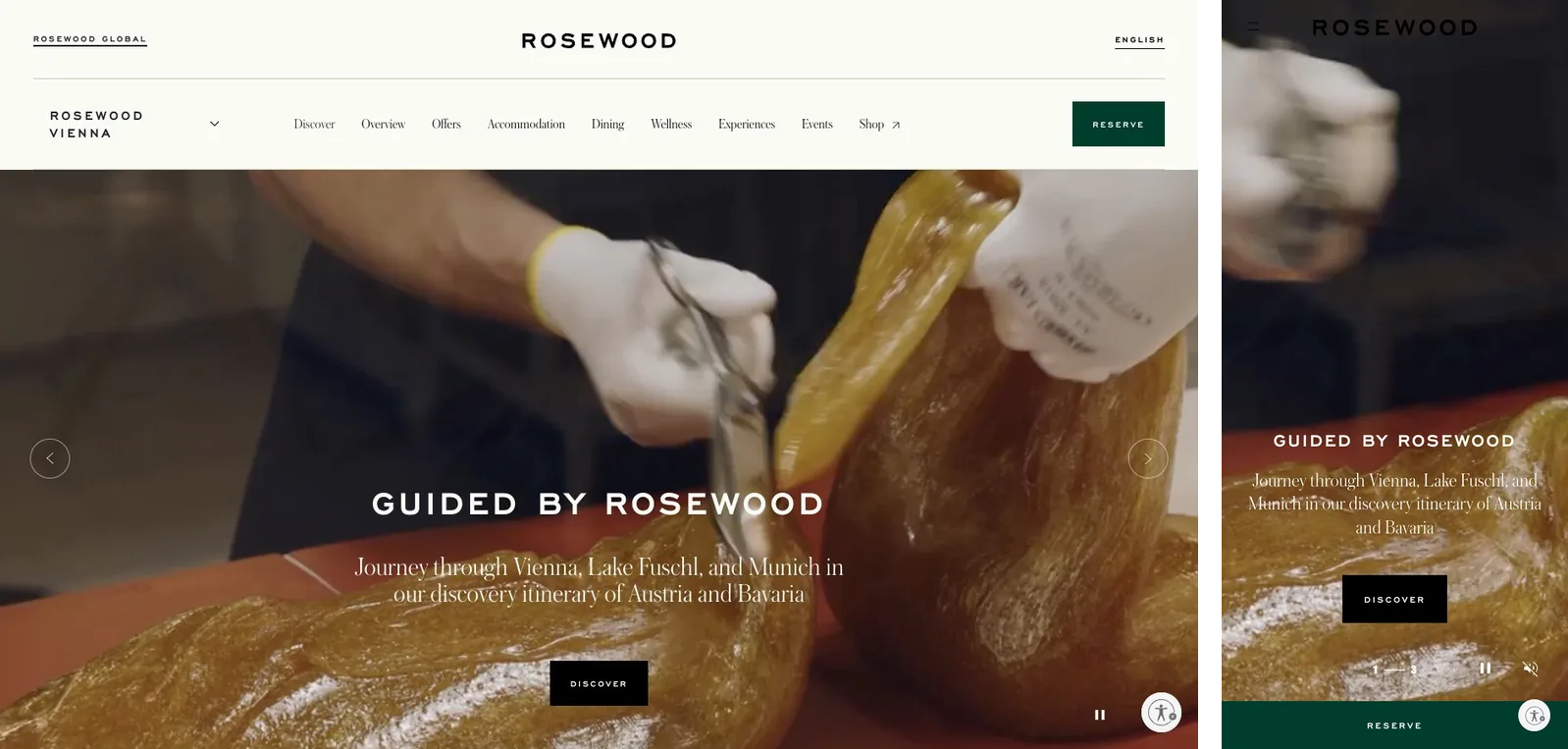
It is a lovely film about the city, and the Hotel Sacher, in the same Vienna, could shoot it frame for frame. The fix is small: open on the house, its façade, a room, the bar, and let the city come second. The brand campaign can sit further down the page, once the guest knows where they are.
Should a hotel website open on a video or a photo?
What it shows matters more than the format. A well-composed still photograph of the house is worth more than a film of shots that could sit on anyone’s website. And the films we measured are cut fast, like an advert: we downloaded 142 of them from the 200 hotels’ websites and analysed them frame by frame.
- 30
- seconds: how long a typical opening film runs
- 18
- shots in a typical film
- 130 of 142
- films that restart on a hard cut
Medians across the 142 opening films of the 200 hotels, measured by Lumina on 23 and 24 November 2026. A shot usually lasts 1.48 seconds.
A shot usually lasts about a second and a half. And not one of the 142 films restarts without the join showing: 130 go back to the beginning on a hard cut, 8 through black, 4 on a soft cut. Anyone who stays on the page sees the film jump.
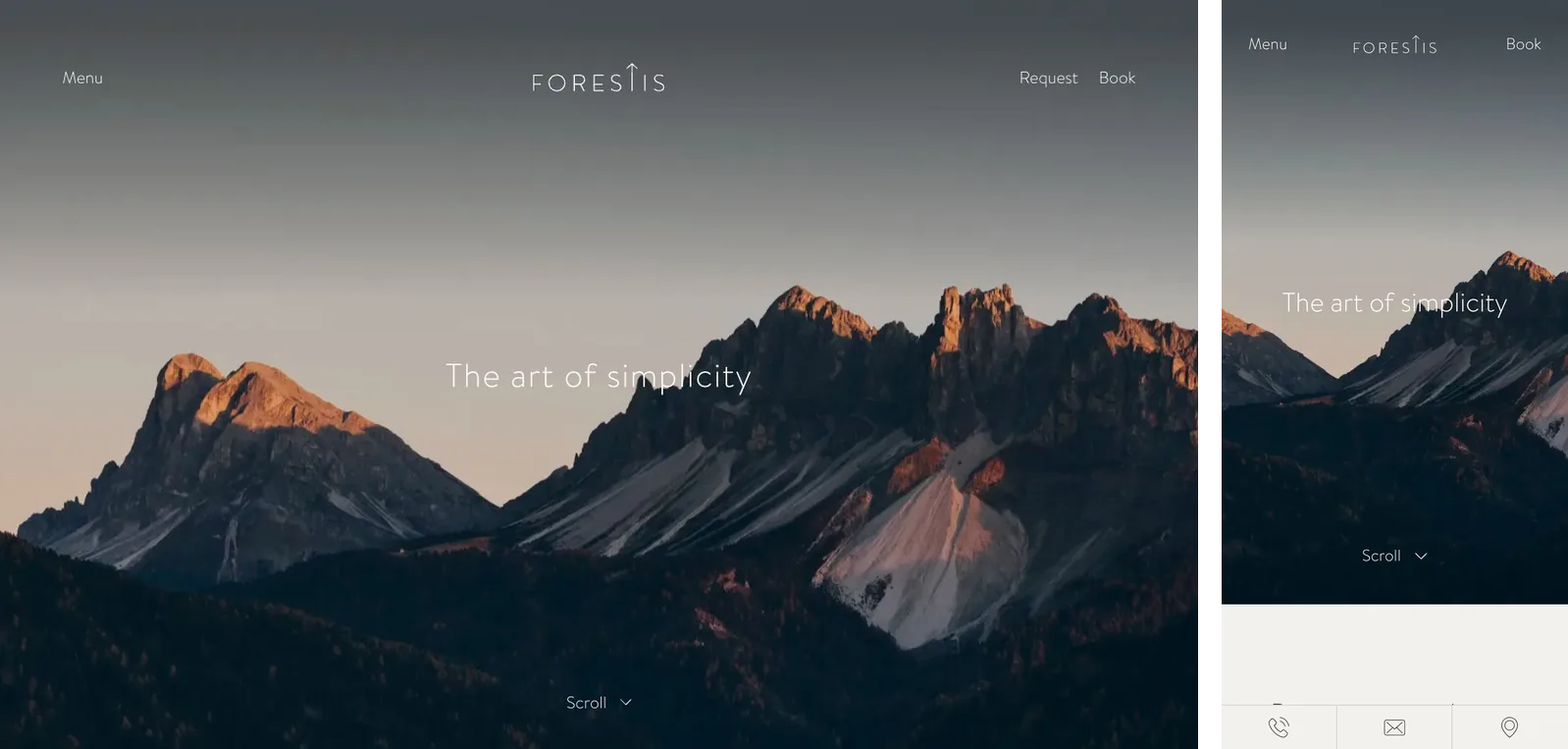
Forestis, in the Dolomites, opens on a still photograph: the Odle peaks at dawn, with the line “The art of simplicity”. On desktop and phone it is one of the cleanest first screens in the sample. But the Odle can be seen from every hotel in the valley, and the house’s towers are not in the picture: I would put them in the frame, small if need be, in front of the mountains.
What does a guest actually see in the first few seconds?
The guest sees the still image the site shows until the film starts, which developers call the poster. In our captures movement usually arrived after about 7 seconds, across 106 films whose start we recorded. The page was loading alongside others, so on a good connection it may start sooner; but of 120 films in the page, 16 were still not moving at 9 seconds.
Browsers have their own rules. Chrome lets a video start by itself when it has no sound, and on the iPhone Safari wants the video muted and marked to play inside the page, and pauses it once it scrolls off screen. When Google measures how long the largest element of a page takes to appear, for a video it counts the poster or the first frame, whichever comes first, and it calls 2.5 seconds or less good.
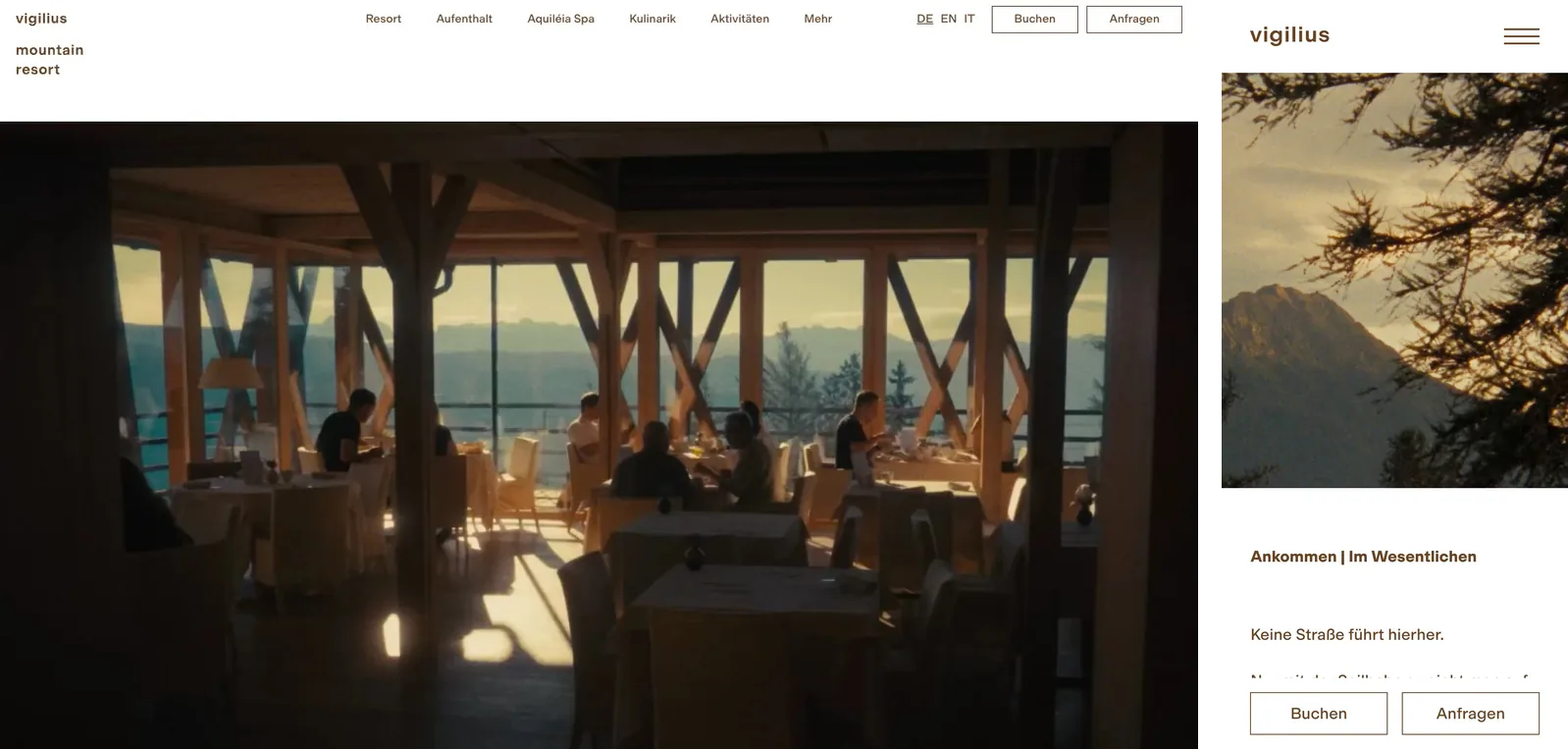
Vigilius, above Lana, gets this right, perhaps without meaning to. On desktop, in an ordinary visit, its film did not start: at 4 and at 9 seconds the screen was identical. But the poster is the dining room under its timber beams, with the sun coming in between the uprights: a photograph of the house that stands on its own. The same light comes back in 5 of the 7 frames of the film. The poster should be composed as the site’s main photograph, because for many guests that is exactly what it is.
Where does the picture start on the page?
In one case out of two, lower than you would think. On desktop, of 145 films on the first screen, 72 start more than 150 pixels below the top edge: above them sit the menu, the name, a notice.
72 of 145
films on desktop that start more than 150 pixels below the top of the screen.
Lumina’s captures of 23 and 24 November 2026, on a 1440×900 screen: films in the page or in an embedded player.
At the Caruso in Ravello, the film sits below a seasonal-closure notice, the menu, the crest and the name. It starts at 477 pixels, and before you scroll you see only 54% of it. In 10 seconds it runs through 12 shots: the arches of the loggia over the sea, which belong to the Caruso alone, go by in a second and a half, and when we looked at 9 seconds the screen showed a figure in silhouette against the sunset.
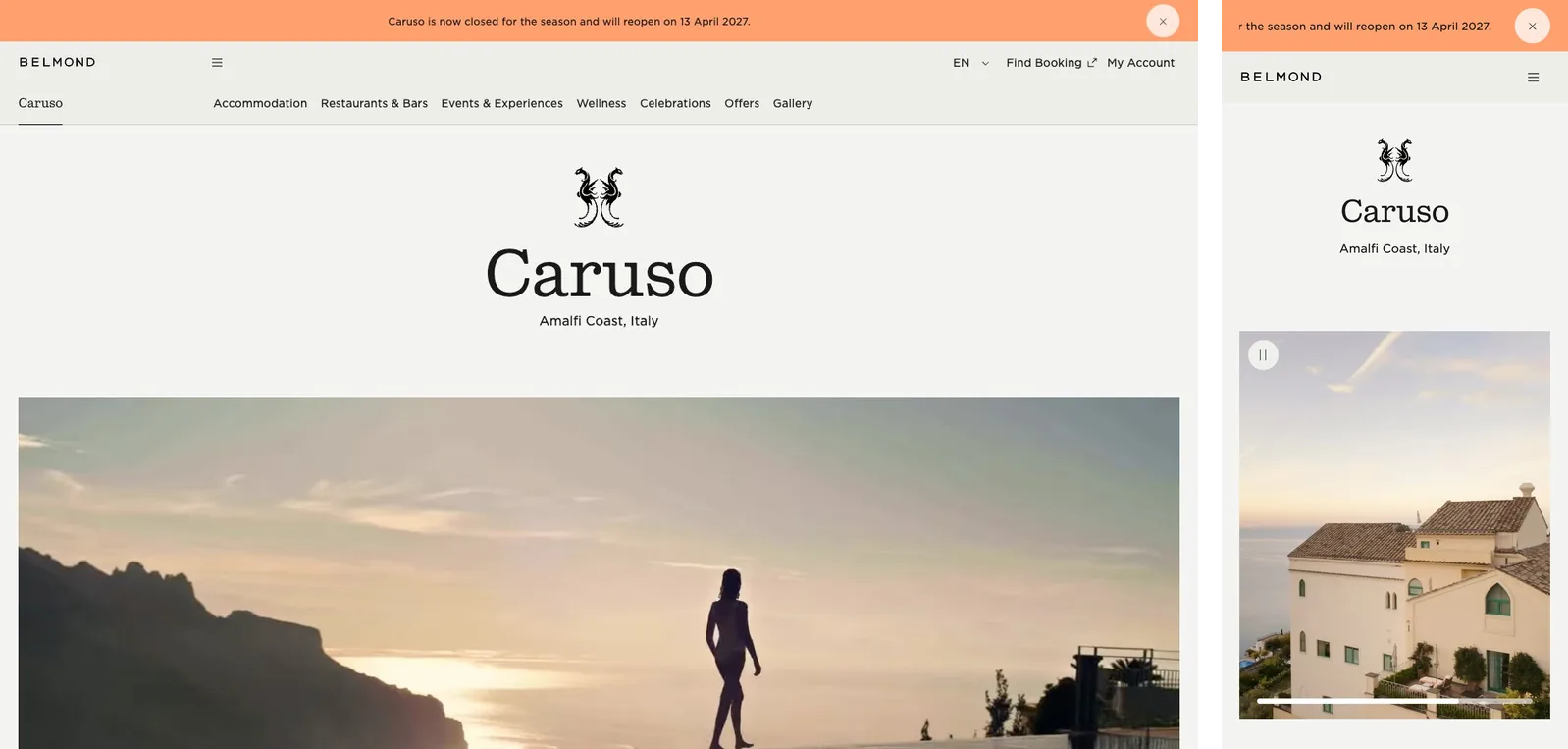
I would do three things: put the name on the picture instead of in a white band above it; start the film under the menu; open on the loggia, held long enough to recognise it. The rest of the film can stay as it is.
How much of the first screen is left on a phone?
Often less than half. On the phone, at 51 websites out of 200 the photograph or film fills less than half of the first screen; on desktop that happens at 17. 27 of those 51 are Belmond hotels, which all share one layout: the picture takes 46.5% of the screen. Le Sirenuse, too, shrinks its film to a strip on the phone.
Lumina’s captures of 23 and 24 November 2026: phone 390×844 pixels, desktop 1440×900, screenshot after 9 seconds.
Then there are the notices. At the first second a cookie or privacy notice was on screen at 89 websites on desktop and 91 on the phone. Il Pellicano, on the Argentario, opens on a still photograph that is beautiful and entirely its own: the terrace on the rocks, red loungers among the pines. After 9 seconds on the phone, the privacy notice and a postcard for Villa La Cicala cover nearly all of it.
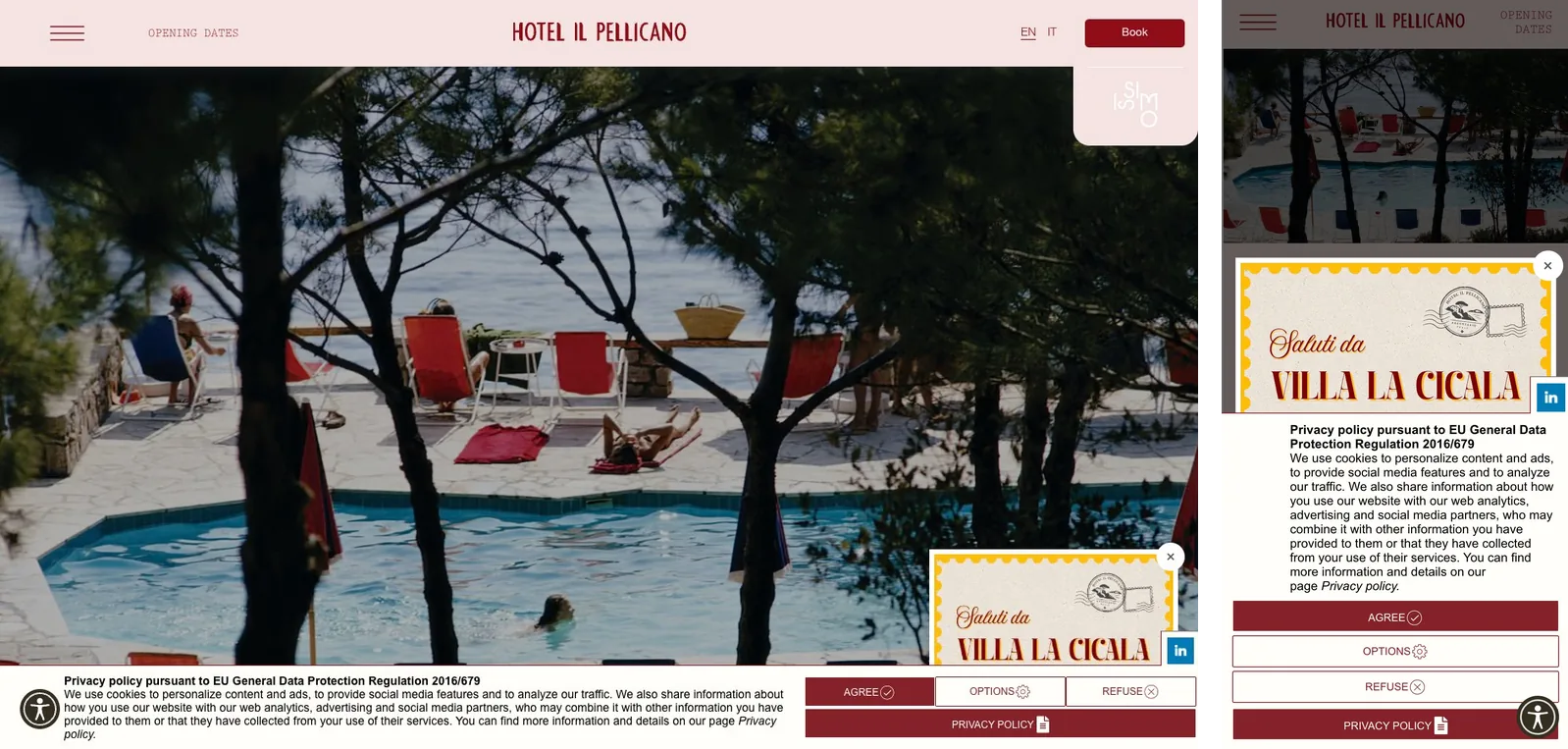
The cookie notice depends on the country the guest is in; the postcard is the hotel’s choice. An offer can sit in a single line under the picture, or arrive once the guest has scrolled. And the test has to be on a real phone, waiting 9 seconds.
Template, builder or designer: what suits a boutique hotel website?
It depends on who will do the work after launch, but in all three cases the first screen is yours to fill. A template gives you the structure of the page; a website builder also gives you somewhere to publish it; neither knows what is unique about your house. On 25 November 2026 we opened the price lists of three different routes.
| Route | What it costs, as shown in the UK on 25 November 2026 | What you get | What is left to you |
|---|---|---|---|
| Squarespace, a general website builder | Basic £16 a month, or £12 paying yearly; Core £24, or £17 | Templates and hosting; on a yearly plan the domain is free for the first year | Connecting the booking engine; the photographs and the film |
| Webflow with a hotel template | Basic site $15 a month, Premium with a content system $25, paying yearly; the Otello template $79 once | 90 hotel templates in the catalogue and freedom over the design | Replacing the demo photographs, which on the Otello template come from Pexels; someone who can work in Webflow |
| Little Hotelier, software for small hotels | Basics from £29 a month plus a 1% fee on each booking, excluding tax; the website builder is an add-on to the Pro plan, which starts at £85 | Booking engine, channel manager and calendar in one account | Everything that goes on the first screen |
I would start from the booking engine you already have, and choose the tool that connects to it without rebuilding everything. I would buy a template for its structure, never for its photographs: a template’s demo photographs are the same for everyone who buys it. If you hand the site to an agency instead, read who builds hotel websites and what to put in the contract before you sign.
What should a boutique hotel website put on its first screen?
Something only your house has, the name and a way to book, all visible on the phone too. Everything else can wait further down.
Choose the mark of the house
An architecture, a colour, a ritual, a piece of your history: something the hotel next door cannot photograph. The view on its own, the neighbours have too.
Compose the poster as your main photograph
Many guests will look at it for several seconds, and some will see nothing else. It has to hold up when still.
If you make a film, keep it short and about the house
A few long shots, the mark of the house coming back, an ending that joins the beginning. A fast-cut brand film can live further down.
Start the picture under the menu
The name can sit on the picture. A white band with a title above the film pushes the photograph off the screen.
Keep the photograph clear for 9 seconds
Do not put offers over the picture as it opens. If you need a cookie notice, keep it small and at the bottom.
Test it on a phone
Open the site on a real phone, wait 9 seconds and see what is left: the picture, the name, the Book button.
The Book button matters more than it seems: across 405 luxury hotels the hotel’s own site cost less than the big booking sites, or the same, for 59% of stays, and a guest already on your site should not have to hunt for it. Below the first screen, put the facts a guest looks for before booking, written as text, as every page of our hotel guide does: they are also what ChatGPT and Gemini read before recommending a hotel.
What should you ask a designer before they start?
Ask them to show you the first screen as the guest will see it, before the rest of the site: on desktop and on the phone, at 1, 4 and 9 seconds. These are the questions we asked ourselves looking at the 200.
What is the poster?
Have it shown full screen. If it does not work as a photograph, change it before the film is shot.
Which shot could the neighbour film?
Line the shots up and mark the ones that would look just as right on the website of the hotel next door. Those go to the end, or out.
Where does the picture start?
In pixels on desktop, and how much of it shows on the phone before scrolling.
How does the film end?
If it restarts on a cut, ask for an ending that returns to the first shot.
What covers the photograph?
Notices, offers, chat windows, booking boxes: what appears, and after how many seconds.
Who owns the photographs and the film?
The original files, at full resolution, should stay with the hotel.
The rest of the contract, from the domain to the accounts, is in our article on who builds hotel websites.
How did we count?
We opened every website the way a guest opens it and counted what was on the screen; the judgement of what belongs to the house was made by looking, by us and by AI reviewers. The detail is below.
Every count, the sample and the limits
The sample. We started from 278 hotels: every open hotel of Aman, Belmond, Rosewood, One&Only and Janu, and 158 independents or hotels of small groups taken from the 2026 lists (World’s 50 Best Hotels, Forbes Travel Guide, Condé Nast Traveller Gold List, Michelin Keys). Looking at their first screens we kept 200, in 61 countries, to spread the places: beach 41, city 37, historic houses 23, mountains 20, countryside 19, islands 18, jungle 14, lakes and rivers 12, desert 9, safari 7. They are luxury hotels: a boutique hotel will find its most ambitious neighbours among them.
How. Every site opened in Chrome on 23 and 24 November 2026, on desktop at 1440×900 pixels and on the phone at 390×844, with a screenshot after 1, 4 and 9 seconds. 18 pages that at 9 seconds still showed a loading screen or a blank page were opened again on 24 November. The films were downloaded from the sites and measured frame by frame. On 25 November we recounted everything from the files.
| What | How many |
|---|---|
| First screen on desktop: a film in the page | 120 of 200, 16 of them still not moving at 9 seconds |
| A film inside an embedded player | 24 of 200 |
| A still photograph | 40 of 200 |
| A sequence of photographs | 16 of 200 |
| Films measured from the site’s own file | 142 |
| Length of a film, median | 30 seconds; half between 15 and 68 |
| Shots per film, median | 18; half between 10 and 41 |
| Length of a shot, median | 1.48 seconds; half between 1.04 and 2.08 |
| How the film restarts | 130 hard cut, 8 through black, 4 soft cut, 0 seamless |
| Films on desktop starting more than 150 pixels below the top | 72 of 145; typical position 146 pixels |
| Seconds before movement, median | 6.9, across 106 films whose start was recorded |
| Photograph or film filling less than half the first screen | 17 of 200 on desktop, 51 of 200 on the phone |
| Cookie or privacy notice at the first second | 89 of 200 on desktop, 91 of 200 on the phone |
| Opening with a mark of the house | 97 of 193 readable openings |
| Opening with the place alone | 30 of 193 |
| A mark of the house returning in at least 3 shots | 44 of 200: architecture 34, colour 6, history 3, ritual 1 |
| No shot that holds up against the neighbour | 50 of 200 |
| Opening with the house, by setting | desert 6 of 7, countryside 11 of 19, beach 22 of 41, city 16 of 37, islands 5 of 16 |
The judgements made by eye. “House” or “place” cannot be measured. On 24 November we classified 27 hotels by hand, in three groups of neighbours; then four AI reviewers applied the same rules to all 200, looking at 7 frames per hotel and comparing each with a neighbour of the same kind. They are judgements, and we treat them as such.
The limits. Timings were measured with the browser opening several pages at once: on a good connection films may start sooner. Cookie notices change with the visitor’s country. The automatic count of photograph sequences went wrong when only a small box on the page changed; we corrected it by eye on the 30 hotels we studied most closely, and a few errors may remain among the other 170.
Questions hotels ask
- What is the best boutique hotel website?
- The one whose first screen shows something only your house has and lets a guest book from the phone. Among the 200 we looked at on 23 and 24 November 2026, The Newt in Somerset does it with a winter ritual of its own, Le Sirenuse with its red and its maiolica, Vigilius with the light falling into its dining room.
- How much does a hotel website template cost?
- On Webflow, on 25 November 2026, the Otello hotel template cost $79 once, and the site $15 or $25 a month paying yearly. The template gives you the structure of the page; its demo photographs have to be replaced with yours.
- Should a hotel website open with a video or a photo?
- Of the 200 websites we captured, 144 open on a film and 40 on a still photograph. A film works if its poster stands on its own, because the guest looks at it for a few seconds: in our captures movement usually arrived after about 7 seconds. A well-composed still of the house is worth more than a film of shots anyone could have.
- How long should the video on the first screen be?
- Across the 142 films we measured, the typical length is 30 seconds with 18 shots, and not one restarts without a visible cut. I would make a shorter film, with a few long shots of the house, that ends where it begins.
- Can I use stock photos on a hotel website?
- To try out a template, yes; on the first screen, no, because a photograph anyone can buy shows a place that is not yours. On Webflow’s Otello template, for example, the demo photographs come from Pexels.
Want to know what a guest sees when they open your website?

Marco Di CesareFounder of Lumina
We looked at 200 first screens on desktop and phone. Before the demo Lumina reads your website, your reviews and your competitors: in 15 minutes you see what it found and the first work it would do. If you would rather ask me something first, we can talk for 30 minutes.
 All of this was read on 25 November 2026, and platforms change their minds often: every claim links back to its page.
Where we read it (15)
- Google, web.dev: Largest Contentful Paint (updated 4 September 2025)
- Chrome for Developers: autoplay policy in Chrome
- WebKit: new video policies for iOS
- Squarespace, pricing in the UK
- Webflow, pricing
- Webflow, hotel website templates
- Webflow, the Otello template
- Little Hotelier, pricing in the UK
- The Newt in Somerset, website
- Le Sirenuse, website
- Rosewood Vienna, the hotel’s page
- Forestis, website
- vigilius mountain resort, website
- Caruso, A Belmond Hotel, the hotel’s page
- Hotel Il Pellicano, the hotel’s page