'%3E%3Cg transform='translate(0,0.0) scale(5.23438)'%3E%3Cpath d='M34 128 a94 94 0 1 0 188 0 a94 94 0 1 0 -188 0 Z M98 128 a52 52 0 1 0 104 0 a52 52 0 1 0 -104 0 Z' fill='%23FFFFFF' fill-rule='evenodd'/%3E%3C/g%3E%3Cg transform='translate(1455.0,302.5)'%3E%3Cg transform='translate(-84.0,729.0) scale(1,-1)'%3E%3Cpath d='M182.0 723V91H500.0V0H84.0V723Z M908.0 489H1001.0V0H917.0L907.0 74Q886.0 35 841.0 11.5Q796.0 -12 742.0 -12Q658.0 -12 611.0 41.0Q564.0 94 564.0 185V489H658.0V216Q658.0 71 775.0 71Q840.0 71 874.0 112.0Q908.0 153 908.0 231Z M1001.0 0H907.0V489H991.0L1000.0 425Q1019.0 461 1057.5 482.0Q1096.0 503 1146.0 503Q1260.0 503 1301.0 404Q1318.0 450 1360.0 476.5Q1402.0 503 1459.0 503Q1543.0 503 1591.0 454.0Q1639.0 405 1639.0 320V0H1547.0V297Q1547.0 354 1517.5 386.0Q1488.0 418 1438.0 418Q1385.0 418 1352.5 383.0Q1320.0 348 1320.0 290V0H1227.0V298Q1227.0 355 1198.0 386.0Q1169.0 417 1119.0 417Q1065.0 417 1033.0 382.5Q1001.0 348 1001.0 290Z M1749.0 0V489H1843.0V0Z M2053.0 0H1959.0V489H2044.0L2054.0 414Q2077.0 456 2120.5 479.5Q2164.0 503 2216.0 503Q2310.0 503 2357.0 449.5Q2404.0 396 2404.0 299V0H2310.0V278Q2310.0 417 2192.0 417Q2127.0 417 2090.0 374.0Q2053.0 331 2053.0 259Z M2657.0 -12Q2579.0 -12 2534.5 28.5Q2490.0 69 2490.0 136.0Q2490.0 203 2537.5 243.5Q2585.0 284 2672.0 291L2826.0 303V317Q2826.0 428 2711.0 428Q2652.0 428 2619.5 403.0Q2587.0 378 2587.0 334H2505.0Q2505.0 410 2562.5 456.5Q2620.0 503 2715.0 503Q2809.0 503 2863.5 453.0Q2918.0 403 2918.0 307V0H2838.0L2828.0 79Q2809.0 37 2762.5 12.5Q2716.0 -12 2657.0 -12ZM2684.0 61Q2751.0 61 2789.0 101.5Q2827.0 142 2827.0 211V237L2702.0 227Q2585.0 216 2585.0 139Q2585.0 101 2611.0 81.0Q2637.0 61 2684.0 61Z' fill='%23FFFFFF'/%3E%3Cpath d='M1733.0 667Q1733.0 693 1751.0 711.0Q1769.0 729 1795.0 729.0Q1821.0 729 1839.0 711.0Q1857.0 693 1857.0 667Q1857.0 642 1839.0 623.5Q1821.0 605 1795.0 605.0Q1769.0 605 1751.0 623.5Q1733.0 642 1733.0 667Z' fill='%23FFFFFF'/%3E%3C/g%3E%3C/g%3E%3C/g%3E%3C/svg%3E)

Why did we ask ChatGPT 792 questions?
Because on 31 October the co-founder of a travel company wrote to us. He had asked ChatGPT about a Las Vegas hotel, and the answer cited our page on the Venetian’s prices. That was why he got in touch, and it left us wondering how the page had ended up there.
In the screenshot, the answer called our page “an independent published comparison”, then reined itself in: “historical quotes, not current offers”. It went on to list what a fair comparison would need: the same date from Booking.com and from the Venetian itself, the same suite, the cancellation terms, the total to pay, and whether the 55-dollar resort fee was in or out. ChatGPT had just written our to-do list.
Our own logs already hinted at something. When ChatGPT opens a page while answering someone, it does so with an agent called ChatGPT-User, and OpenAI says that agent acts when a user asks a question and is not used to crawl the web automatically. In October, page for page, it opened our price pages far more often than our hotel pages.
- 584 on 47
- times ChatGPT opened our price pages, across 47 pages: 12.4 a page
- 1,390 on 434
- times it opened the guide’s hotel pages: 3.2 a page
- 65
- visits from ChatGPT to the price pages in the same month
luminafrontier.ai visit log, October 2026, ChatGPT-User agent. An opening means the page was read during an answer, not that it was shown or cited.
So we put to ChatGPT the questions of a traveller trying to find out what a hotel costs: the price a night, the cheapest month, where to book, the total with taxes, one booking site against another, the hotel against the booking site. 792 questions about 149 hotels and 14 destinations, on 31 October 2026, then 136 of them again to see whether the answers held.
One thing to say once, and plainly: we questioned a ChatGPT model through the API, with web search switched on and a US location, not the app a traveller has on their phone. We wrote the questions ourselves, so the rates describe this test, not real traffic.
How the test was built
792 questions, 764 in English and 28 in Italian, in 6 kinds of question for hotels and 5 for destinations: 136 about hotels with a price page in the guide, 172 about guide hotels without one, 288 about hotels outside the guide, 196 about destinations.
For each answer we kept the text, the links it cited, the pages its search found and the searches the model ran by itself. The 136 questions about hotels with a price page were asked a second time, and 60 questions drawn from across the groups were also put to a second model.
“Cited” means a link in the answer; “found” means the page was among the results of the model’s own search.
Does ChatGPT know hotel prices?
Yes, and it nearly always gives one: there is a price in 95 of 99 answers to “how much is a night”. What is missing is the night. Only 18 of 99 answers say which date the price is for, and 95 end by asking for yours.
18 of 99
answers about a hotel’s price a night that say which night the price is for. 95 give a price.
Lumina test, 31 October 2026: 99 questions about a hotel’s nightly price.
A typical answer goes like this. Asked what a night at the Standard, High Line in New York costs, ChatGPT said roughly 400 to 500 dollars a night including taxes and fees, for some dates, and much more on busy nights; tell me your dates and I’ll look for an exact rate. Its source was Expedia. It is an honest answer and almost no use: which dates, which room, read when?
That finding killed one of our own ideas. In tests built on advice questions, the “where should I stay in…” kind, a price hardly ever appeared, and we said so in our piece on ChatGPT ads for hotels. We had concluded that ChatGPT simply didn’t have prices. Ask it for the price, though, and you get one. It lacks the date, and the date is exactly what a hotel holds.
What does ChatGPT search for before it answers?
It looks for the official site and the booking site together, and often adds the year by itself. Across 792 questions the model ran 1,776 searches of its own: 790 named a booking site, 616 contained the word “official”, 508 a year. The commonest shapes ran along the lines of “hotel name, official, Expedia, rates”.
Lumina test, 31 October 2026: the searches the model ran by itself to answer 792 price questions.
Identical searches barely recur, 1,632 different forms in 1,776, but the pattern does: it wants to set the official source beside the one that sells. Reviews and forums it doesn’t look for: “review” appears twice, “reddit” never.
Then it comes down to who turns up first. Within an answer, the first page the search finds is cited 51% of the time, the second 23%, the fifth 6%. Much of the game is played before a word of the answer is written.
Lumina test, 31 October 2026, 750 answers citing at least one page: for each answer, the position of every page among those the model’s search found.
Who gets cited when the question is price?
The booking sites and Google, well ahead of anyone else. Expedia is among the sources in 136 of 792 answers, Google Hotels pages in 125, Kayak in 86. Of the 596 questions about a named hotel, 379 cite at least one booking site or Google Hotels.
Lumina test, 31 October 2026: answers citing at least one page from that source, of 792. Google Hotels pages come from many of Google’s country domains and are counted together here.
Each has its own question. Kayak takes the cheapest month, cited in 66 answers of 100; Expedia the price a night, 52 of 99; Google Hotels the question of where to book, 34 of 99, and the one between 2 booking sites, 32 of 99.
Forums and review sites ChatGPT finds and almost never cites: 1 citation in 4,911 pages found. On prices, Reddit stays bedtime reading.
Where does the hotel’s own site win?
On how the bill works and on “direct or booking site?”, where the hotel’s site is cited more often than any booking site. On the price a night and the right month, the hotel all but disappears.
| What the traveller asks | Answers citing the hotel’s or its chain’s site | Answers citing a booking site or Google Hotels |
|---|---|---|
| Is it better to book direct or on a booking site? | 61 of 100 | 54 of 100 |
| Where can I book it for the lowest price? | 46 of 99 | 49 of 99 |
| What will I pay in all, with taxes and resort fee? | 35 of 99 | 62 of 99 |
| What is the cheapest month? | 11 of 100 | 83 of 100 |
| How much is a night? | 11 of 99 | 80 of 99 |
| Is one booking site cheaper than another? | 9 of 99 | 51 of 99 |
Many of the official pages that get cited are of one kind: the Broadmoor’s hotel policies, Marina Bay Sands’ booking terms, Resorts World Las Vegas’s offer with no resort fee, La Mamounia’s FAQ. Pages that say how the bill works. In the United States that bill also has a rule: since 12 May 2025 the Federal Trade Commission has required a mandatory resort fee to sit inside the total price shown.
How we recognised the hotel’s own site
A link counts as the hotel’s site when its domain holds a distinctive word of the hotel’s name, or belongs to a chain such as marriott.com, fourseasons.com or aman.com. A few official sites with a different name slip through, so the figures in the first column are a floor.
The 596 questions are those about a named hotel, the first time we asked them, on 31 October. One answer can cite the hotel and a booking site together, so the 2 columns do not add up.
To my mind this is the lesson for anyone running a hotel. The booking sites have won “how much”, because they hold the price with its date. “How does it work”, with taxes, fees, cancellation and the perks of booking direct, goes to whoever writes it clearly on their own site.
Why does ChatGPT cite Lumina, and only there?
Only where we have a price page, and I think because it is the missing page: a price with its date, in a table. Lumina is cited in 12 answers of 792, and all 12 fall among the 136 questions about hotels with a price page in the guide. On guide hotels without one: 0 of 172. The page cited is not always the price page: of the 12 answers, 6 cite the price page and 6 the hotel page, which on hotels without a price page is never cited at all.
- 12 of 136
- questions cite Lumina, on hotels with one of our price pages
- 0 of 172
- on guide hotels without a price page
- 11 of 136
- asking the same questions again
Lumina test, 31 October 2026. On the 196 destination questions, where we have no price pages, Lumina was neither cited nor found.
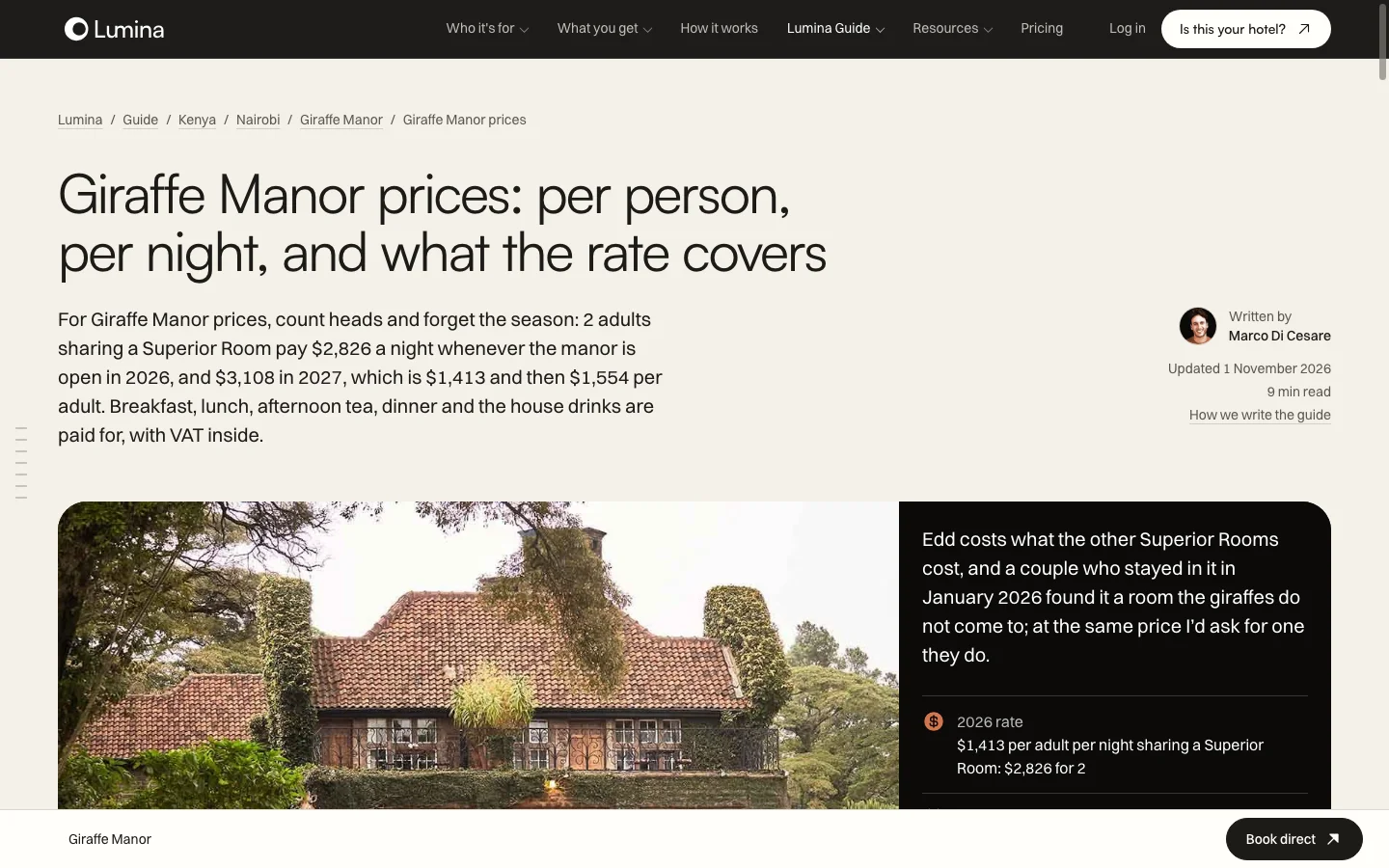
Take Giraffe Manor, in Nairobi. Asked what one night costs with taxes and fees, ChatGPT answered with the figures from our page:
For 2026, one night at Giraffe Manor is US$1,413 per adult sharing a room—so US$2,826 total for two adults. The published rate is an all-inclusive rate, so taxes and standard service charges are included; there’s no separate resort fee listed.
ChatGPT’s answer in our test, 31 October 2026, quoted as given. Its only source was our page on Giraffe Manor’s prices.
There is a second reason, and it concerns the booking sites. We split the hotels with a price page into 2 groups: those the booking sites cover thinly, where the model’s search found one of their listings in at most 2 questions of 4, and the rest. Where booking sites are thin, our page is found in 32 questions of 40; where they are dense, in 47 of 96. The first group holds 10 hotels, and nearly all have a family likeness: Amanjiwo, Blackberry Farm, Eden Rock, Aman New York, Giraffe Manor, Ritz Paris, Amangiri, Claridge’s; the exceptions are Beaches Turks & Caicos and Atlantis Paradise Island. Many of them, I think, are booked by writing to the hotel rather than by clicking.
Position matters here too. When our page came 1st or 2nd in the model’s search, counting both times we asked, it was cited in 14 cases of 57; from 6th down, in 2 of 52. Of 40 price pages from other sites that ChatGPT cited, 16 had a table, 15 at least 5 prices, 13 a date in the text. None had a price in the title.
What died along the way?
More ideas than survived, and that’s as it should be: each was something we could have sold to a hotel. These 4 don’t stand up.
ChatGPT has no prices
It has them, in 95 answers of 99 when you ask. What it lacks is the dates.
A page read is a page clicked
In Las Vegas ChatGPT opened our 4 price pages 237 times in October, and they received 6 visits. The other price pages: 347 openings, 59 visits.
A single answer settles it
Of the 20 questions in which Lumina was cited at least once, only 3 cited it both times we asked. Counted by group, it holds: 12 of 136, then 11 of 136.
A price page lifts the hotel’s other pages too
Openings of the other pages rose 3.44-fold on hotels with a price page and 3.19-fold on the rest, from 1–11 to 18–27 October. The whole site rose.
And there is one thing we can’t explain. In our test the Las Vegas price pages were never cited, 0 times in 32 questions, counting both times we asked, yet one of them is exactly what the real app showed the co-founder who wrote to us. A model through the API and the app on a phone are not the same thing, and that zero proves no absence.
What this test does not tell you
We did not open the ChatGPT app travellers use, beyond the screenshot that reached us by email. We don’t know how many citations become clicks, or how many become bookings.
The hotels with a price page were not chosen at random, so the type and fame of a hotel are mixed up with the effect of the page. That thin booking-site coverage helps remains an association: we have not proved the cause.
The same questions put twice to the same model overlap by only half in the domains they cite, and 2 different models less still. Read the rates on this page by group, never from a single answer.
What would I do if I ran a hotel?
I’d publish myself the answer ChatGPT now fetches from Expedia, and put it where it looks. There are 5 moves, and each comes with the evidence that made me choose it.
A price page of your own, with nights and dates
A table with the room, the night, the price and the day you read it, month by month. The evidence: 95 answers of 99 give a price and only 18 say for which night, and Lumina is cited in 12 questions of 136 where it has this page, in 0 of 172 where it hasn’t.
The whole bill, explained on your own site
Taxes, resort fee, what the rate includes, until when you can cancel. The evidence: on “direct or booking site?” the hotel’s site is cited in 61 answers of 100, on the total with taxes in 35 of 99.
The words ChatGPT searches with
Name the page the way it searches: official rates, prices a night, the year. The evidence: “official” appears in 616 of its 1,776 searches, a year in 508, and the first page found is cited 51% of the time.
Start where the booking sites say little
If your hotel sells mostly on enquiry, the field is more open. The evidence: where booking sites are thin our price page is found in 32 questions of 40, where they are dense in 47 of 96.
Measure readings and visits, not only citations
Look in your site’s logs at how often ChatGPT-User opens your pages and how many visits come from chatgpt.com, and put your direct booking beside the price. The evidence: in Las Vegas, 237 openings went with 6 visits.
A page like this replaces none of the others. For getting the hotel’s name into answers when the question starts from the trip rather than the price, there’s our guide on how to get your hotel on ChatGPT, and our August study of 3,288 answers from ChatGPT, Claude and Gemini shows how hard that is: on questions about the trip, only 189 answers of 1,380 named one of the world’s 50 best hotels. And if you wonder who sells your hotel below your own price, we measured that in is it cheaper to book directly with the hotel.
Inside ChatGPT and Claude, Lumina’s app shows the prices collected for the nights you ask about, with the day we read them. I’d still start with the hotel’s own site: it is the source ChatGPT searches for with the word “official”, and the hotel is the one that sets the night, the room and the bill.
Questions hotels ask
- Does ChatGPT give hotel prices?
- Yes, when you ask: in our test there was a price in 95 answers of 99 to the question about the price a night. It rarely says which night the price is for, 18 times in 99, and nearly always ends by asking for your dates.
- Where does ChatGPT get hotel prices from?
- Mostly from booking sites and Google: of 792 answers, Expedia is cited in 136, Google Hotels pages in 125, Kayak in 86, Booking.com in 52. Before answering it searches for the official site and the booking site together, often with the year.
- Does the hotel’s official site get cited?
- Yes, above all on how the bill works. On whether to book direct or on a booking site, the hotel’s or its chain’s site is cited in 61 answers of 100, on the total with taxes and resort fee in 35 of 99, on the price a night in only 11 of 99.
- Does the ChatGPT app answer as it did in your test?
- We don’t know. We questioned a ChatGPT model through the API with web search, not the app. The Las Vegas price pages, for instance, were never cited in the test, yet the app showed one to the co-founder who wrote to us.
- Is a ChatGPT answer always the same?
- No. Of the 20 questions in which Lumina was cited at least once, only 3 cited it both times we asked. Counted over groups of questions it holds: 12 citations in 136, then 11 in 136.
- Does a price page bring bookings?
- We haven’t measured that. We know that in October ChatGPT opened our price pages 584 times and that the same pages received 65 visits from ChatGPT; in Las Vegas, 237 openings and 6 visits.
Try Lumina on your own hotel

Marco Di CesareFounder of Lumina
Before a demo Lumina reads your website, your reviews and your competitors. In 15 minutes you see what it found and the first work it would do. If you would rather ask me something first, we can talk for 30 minutes.
 All of this was read on 1 November 2026, and platforms change their minds often: every claim links back to its page.
Where we read it (4)
- OpenAI, its crawlers and agents: ChatGPT-User and OAI-SearchBot
- OpenAI, web search in the API: citations and the sources consulted
- DataForSEO, answers from ChatGPT models through the API, with web search and the searches the model runs
- US Federal Trade Commission, rule on unfair or deceptive fees, questions and answers